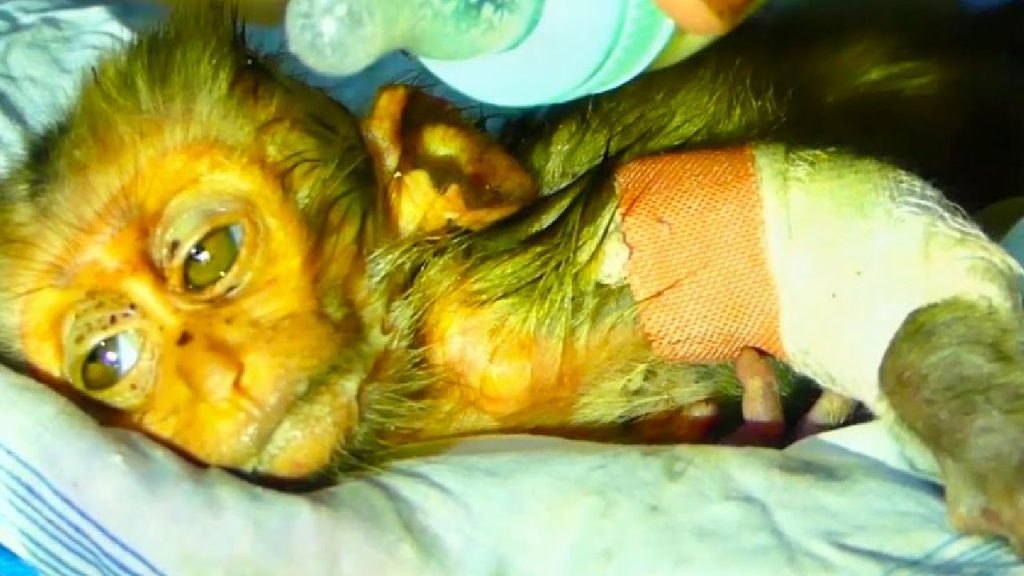
A baby monkey weakened by illness becomes a creature caught between fear and hope, its tiny body struggling to keep pace with breaths that come too fast or too shallow. When rescuers find such infants, the scene always carries the same quiet weight: trembling limbs, half-closed eyes, and the unmistakable stillness that signals a life drifting toward danger. Yet within that frailty lies a spark—small, but fighting—and the rescue begins with the belief that this spark can grow stronger.
The first step is stabilization. Sick baby monkeys, especially those suffering from dehydration, infection, or malnutrition, must be handled gently and slowly. Their muscles lack strength, their immune systems are barely functioning, and every movement costs them precious energy. Rescuers wrap them in soft cloth, keeping them warm because the weak cannot regulate temperature. Warmth is life, and its steady presence often becomes the first comfort they have felt in days.
Hydration and nourishment follow, delivered drop by drop. A severely ill baby monkey often cannot feed on its own; its mouth may not open willingly, and swallowing becomes effort. Special formulas mimic the nutrients it would receive from its mother, rich in calories yet easy to digest. With each swallow, its body receives the quiet message that it is no longer alone, that care surrounds it.
Medical treatment is the next battle. Antibiotics, antifungals, or fluids are given based on what the little body is fighting. Respiratory infections, parasites, fever, and injuries are common among rescued infants, often caused by abandonment, loss of their mother, or human interference. A weak baby monkey may cling weakly to the towel, its small fingers trembling, but even that faint grip is a sign of determination—a sign that it has not given up.
Recovery is never instant. Some days show progress: slightly wider eyes, an attempt to sit up, a small squeak for attention. Other days bring setbacks, when fever returns or appetite vanishes. Rescuers learn to celebrate every tiny victory—a stronger heartbeat, a cleaner breath, a moment of alertness. These small steps add up to survival.
As strength returns, the transformation becomes profound. The once-limp infant begins to grip tighter, crawl farther, and respond to gentle grooming. The spark grows into a glow. What was once a trembling life now shows curiosity, warmth, and the first hints of playful spirit.
Rescuing a weak baby monkey is a quiet, exhausting, and deeply compassionate journey. And when that little creature finally lifts its head and looks at its caregivers with clear eyes, hope becomes real—proof that gentle hands can pull even the smallest life back from the edge.